Go into any brick-and-mortar casino and observe the baccarat pit for ten minutes. You’ll see this immediately: the players are intense. They squeeze cards. They cheer. They groan. There’s a ritual to it that nothing in the world of slot machines can replicate.
Well, live dealer baccarat recreates just that energy onto your screen.

We’re not talking about some random-number generator clicking through a digital animation. We’re talking about a human dealer who’s been trained, an actual eight-deck shoe, real burn cards and a camera feed sharp enough to make out the suit markings clearly. The result is a game that somehow feels more transparent in a way that pure digital games never quite achieve. You can watch the shuffle. You can see the cut. That matters to players who want to believe in the process.
Then there’s the social layer. Live chat, leaderboards, real-time side-bet whoops from other players at the virtual table — it generates real atmosphere. And because baccarat essentially is simple in its decision structure, you can enjoy that atmosphere instead of fretting over every play.
But “simple” doesn’t mean “thoughtless.” The difference between a player who walks in blind and one who knows the math is measured over time in real dollars. This guide closes that gap.
The Math of the Game: House Edge, Laid Bare

Baccarat offers three primary betting positions: Banker, Player, and Tie. That’s it. The strategic conversation begins and ends with understanding what each one actually costs you.
The Core Bet Breakdown
| Bet | House Edge | Payout | Notes |
|---|---|---|---|
| Banker | 1.06% | 0.95:1 (5% commission) | Best bet on the table |
| Player | 1.24% | 1:1 | Second best; no commission |
| Tie | 14.36% | 8:1 (most tables) | Statistically ruinous |
| Tie (9:1 tables) | 4.85% | 9:1 | Still a poor long-term bet |
Let’s put those numbers in plain English. If you’re flat-betting $100 per hand and you play 100 hands in a session, the Banker bet theoretically costs you $10.60. The Player bet costs $12.40. The Tie bet? A theoretical $143.60 loss on the same $10,000 wagered.
The Tie bet isn’t exciting. It’s expensive.
Why Does the Banker Bet Win More?
This confuses newcomers. The Banker wins approximately 50.68% of non-tie decisions—marginally more than the Player’s 49.32%. The reason lies in the drawing rules. The Banker’s third-card draw decision is conditional on the Player’s third card, which gives the Banker position a structural mathematical advantage. The casino claws back part of that edge by charging a 5% commission on Banker wins, which produces that 1.06% house edge.
No commission? The structure shifts. No-Commission Baccarat is a variant where Banker pays 1:1 on most wins but only 0.5:1 when Banker wins with a total of 6. That single rule adjustment produces a house edge of approximately 1.46% on the Banker bet—worse than the standard version. Know which table you’re sitting at before you start.
The “Natural” and Why It Ends Everything
A Natural is when the first two cards dealt to either hand total 8 or 9. If a Natural appears, the hand is over immediately—no third cards are drawn. The Banco (Punto Banco is the full name of the standard game) rules for drawing a third card only apply when neither hand produces a Natural. Understanding this prevents the confusion newcomers feel when they watch a hand end abruptly.
Live Interface Mastery: Reading the Roadmaps (Without Believing the Myths)
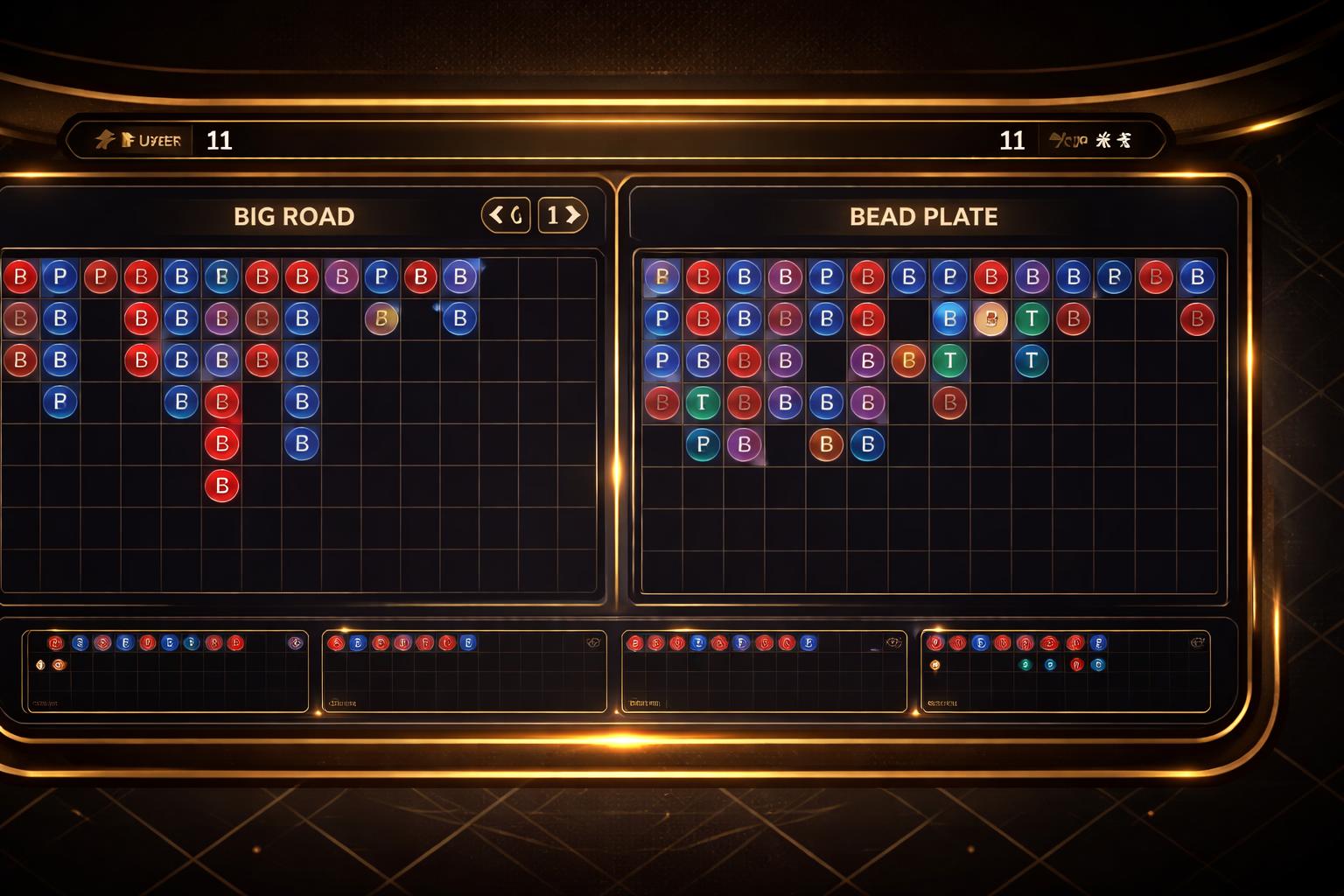
Every live baccarat table displays a cluster of color-coded grids on-screen. These are Roadmaps—visual records of past hand results. They look intimidating at first. They’re actually straightforward.
The Bead Plate (Bead Road)
The simplest of the roadmaps. Results fill in a grid from top to bottom, left to right. Blue circles represent Banker wins. Red circles represent Player wins. Green typically marks a Tie. That’s the whole system. It’s a raw historical record, nothing more.
The Big Road
More visually complex. Banker runs are tracked in one column going downward; when the result changes, a new column begins. A long column of Banker results creates what players call a “Dragon”—an extended streak that looks meaningful but is statistically just variance doing what variance does.
The Derived Roads (Small Road, Big Eye Boy, Cockroach Pig)
These three are generated from the Big Road using offset comparison rules. They track patterns of repetition versus choppiness across the shoe’s history. Regular players use them to decide whether to “follow the shoe” (bet with the last result) or bet against it.
Here’s the professional stance, stated plainly: Roadmaps track history. Baccarat cards have no memory. Each hand is drawn from a shoe that contains the same cards regardless of what happened three hands ago. A shoe that has produced six Banker wins in a row is not “due” for a Player win. The probability resets—approximately—with every new hand.
The roadmaps are entertaining. They give regulars a shared language. They create the illusion of pattern where mostly noise exists. Use them as a mental engagement tool if you enjoy them. Do not let them override basic math.
Betting Systems: What Works, What Doesn’t, and What Bleeds You Dry

No betting system changes the house edge. This is mathematical fact. What systems do change is the shape of your session—how volatility distributes across your bankroll over time.
Negative Progression Systems (Handle With Care)
Martingale Double your bet after every loss. Win once, recover all losses plus one unit profit. This is the most famous system in gambling and the most dangerous one in practice.
The problem is table limits. A $10 starting bet requires $10 → $20 → $40 → $80 → $160 → $320 → $640 after six consecutive losses. That’s $1,270 wagered to win back your original $10. Seven-loss streaks aren’t rare in baccarat. Live tables commonly cap at $5,000–$25,000. The math catches up with everyone eventually.
Martingale produces frequent small wins and occasional catastrophic losses. It feels like a strategy. In practice, it’s variance management theater.
D’Alembert Add one unit after a loss, subtract one unit after a win. Gentler slope than Martingale, meaning slower escalation. The underlying logic—that wins and losses will balance out—is called the Gambler’s Fallacy in academic literature. Slower bleed than Martingale, but the house edge still compounds over time.
Positive Progression Systems (Better Risk Profile)
Paroli Double your bet after a win, up to three consecutive wins, then reset to base. You’re risking profits rather than digging into bankroll reserves. A three-win streak at base $25 produces: $25 → $50 → $100. Win all three, pocket $175 (your $25 back plus $150 profit). Lose at any point, reset.
Paroli has a sensible structure: you need the shoe to deliver short winning streaks, which happen regularly in a 70-80 hand session. It doesn’t change the house edge, but it concentrates your wins during hot runs and limits damage during cold ones.
1-3-2-6 System Bet 1 unit, then 3, then 2, then 6 on consecutive wins. If you complete the four-step cycle, you’ve turned 1 unit of risk into 12 units of profit. If you lose at any step, return to step one. The genius of this system is that after step two, you’re playing with house money—your original stake is already recovered.
For live baccarat with a $25 base unit: 1-3-2-6 translates to $25-$75-$50-$150. Complete the sequence, collect $300 net profit from a $25 initial outlay. Lose on step three, you’ve lost only $25 (won $100 on steps one and two, bet $50 and $25 back). It’s elegant. It’s still not beating the house edge, but it’s a disciplined way to press wins without Martingale’s catastrophic downside.
Flat Betting: The Professional’s Actual Choice
Bet the same amount every hand. Always Banker. Walk away at your stop-loss or take-profit limit.
This sounds boring because it is boring. It is also the only approach that makes mathematical sense over a long sample. Flat Banker betting at 1.06% house edge is the slowest way to lose money at any table game outside of blackjack with perfect basic strategy. No progression system beats flat betting over a sufficiently large sample. Professionals know this and bet flat anyway—managing variance through session limits rather than bet manipulation.
Side Bets: High Risk, Real Numbers

Live baccarat tables routinely offer side bets. They look appealing. The payouts are flashy. The math is usually punishing.
Dragon Bonus
Pays based on the margin of victory of the winning hand. A natural win pays 1:1. A non-natural win by 9 points pays 30:1. Sounds thrilling. The house edge on Dragon Bonus sits at approximately 2.65% on the Player side and 9.37% on the Banker side. The Banker version is particularly ugly—avoid it entirely. The Player version has a higher edge than the main bets but produces the spikes in session variance that some players actively seek.
Either Pair
Pays 5:1 if either the Player hand or Banker hand has a pair in the first two cards. House edge: approximately 2.02% on most eight-deck configurations. This is actually one of the more reasonable side bets mathematically, though it still costs roughly twice what the Banker main bet does.
Perfect Pair
Pays when either hand has an identical pair—same rank, same suit (e.g., two Kings of Spades). Typical payout is 25:1. House edge can range from 13% to 17% depending on the number of decks. This is not a strategic bet. It’s a lottery ticket disguised as a casino side bet. Treat it accordingly.
The Rule on Side Bets: Occasional side bet action as entertainment is fine. Systematic side bet play as part of a session strategy is a guaranteed way to increase your theoretical hourly loss rate substantially. If you want the social enjoyment of a side bet win, set a firm limit—perhaps 5% of session bankroll—and stop when it’s gone.
Bankroll Management: The Framework That Keeps You at the Table
The best strategy in baccarat is the one that keeps you playing long enough to enjoy the game without a single session destroying your wider budget.
The 1% Rule
Never bring more than 1% of your total gambling bankroll to a single baccarat session. If your total designated gambling budget across the month is $2,000, your session buy-in should be $20. This sounds conservative. It prevents the psychological spiral that follows a catastrophic loss.
For players with a per-session mentality, a practical equivalent: bring 100 units to the table. If your base bet is $10, bring $1,000. This gives you enough depth to survive normal variance without being wiped out by a rough 20-hand sequence.
Stop-Loss Limits
Decide in advance: if you lose 40–50% of your session buy-in, you leave. This is not negotiable. In a live dealer environment, it’s easy to reload and tell yourself you’ll recover. That impulse has ended more sessions in disaster than bad luck ever did.
Practical implementation: set your stop-loss in the cashier before you sit down if your platform supports deposit limits. Remove the decision from in-session emotion.
Take-Profit Limits
Win 40–50% of your buy-in? Seriously consider walking. Variance is real. A session that peaks at +$400 can finish at -$100 if you keep playing into the distribution tail. Locking in a win feels less satisfying than chasing a bigger win—and that psychological asymmetry is what casinos rely on.
The live environment adds a specific pressure here: the chat, the atmosphere, the dealer interaction make it easy to stay “just a few more hands.” Build your exit rule before you sit down and treat it like a hard commitment.
FAQ: Straight Answers to Real Questions
Is live dealer baccarat rigged? At licensed operators regulated by bodies like the UK Gambling Commission, Malta Gaming Authority, or Isle of Man Gambling Supervision Commission, no. Live games are audited regularly. The physical shoe, burn cards, and visible dealing process make manipulation functionally impossible in the way a compromised RNG might theoretically be. Check your operator’s licensing credentials. If they’re regulated by a credible jurisdiction, the game is fair.
Can you count cards in live baccarat? Technically, card counting does affect baccarat odds as the shoe depletes. Practically, the edge you can extract is tiny—fractions of a fraction of a percent—and live games typically shuffle at the 50–75% penetration mark, well before a meaningful card-counting advantage develops. Baccarat card counting is not a viable professional strategy. Anyone selling you a “baccarat counting system” is selling fiction.
Should I always bet Banker? In terms of pure house edge, yes—Banker is the best main bet available. The 5% commission is accounted for in the 1.06% figure. However, if you’re on a no-commission table, check whether the Banker-6 rule is in effect, as it raises the Banker edge to around 1.46%. In that case, the gap between Banker and Player narrows considerably.
What’s the best live baccarat table to choose? Lowest minimum bet, eight-deck shoe (not continuous shuffle), standard commission rules. Speed baccarat variants—where deals happen every 27 seconds—compress your hourly theoretical loss rate in terms of time-to-decision but increase the number of hands per hour significantly. Slower pace tables are more bankroll-friendly for the same session duration.
How many hands should I play in a session? That depends on your bankroll. With 100 units and flat betting, a session of 60–80 hands is reasonable. More importantly: your session length should be defined by your stop-loss and take-profit limits, not by clock time. Hit your limit—either direction—and leave.
Play the Math, Ignore the Myths
Live dealer baccarat is one of the most honest games in the casino ecosystem. The house edge is low, the rules are fixed and transparent, and the “skill” involved is almost entirely about discipline rather than decision-making complexity.
The players who lose badly at baccarat aren’t losing because the game is unfair. They’re losing because they chase losses, ignore their stop-loss rules, bet the Tie because the payout looks good, and let Roadmap patterns convince them they’ve spotted something the math hasn’t already accounted for.
Bet Banker. Manage your bankroll. Leave when you hit your limits. Everything else—the systems, the side bets, the streaks—is context.
The live element is real. The atmosphere is real. The house edge is real. Work with all three, and baccarat becomes a thoroughly enjoyable way to spend an evening.