For a few golden years, millions of American players found a clever workaround: most US states didn’t permit people to legally play online slots for real money, but they could log in to a sweepstakes casino, collect free coins, spin the reels, and cash out prizes. The biggest benefit of such gambling platforms is that they don’t require a license. In short, it’s a legal gray area big enough to host a billion-dollar industry. But there are some big changes here.
State regulators across the US have been picking these platforms apart through 2025, and 2026 looks no different. Cease and desist orders are being issued. And on top of that, attorneys general are opening investigations, and the American Gaming Association has been lobbying for years to classify sweepstakes platforms as illegal gambling, and regulators are starting to pay attention now.
So who runs online casino games in America? Who receives the tax revenue? Sweepstakes operators exploited a legal loophole to create a billion-dollar business. Now, states are shutting it down, and they’re not being shy about it.
Here’s what’s gone down, what’s happening, and what’s to come for fans of online slots and virtual table games. Let’s see where this will take us.
The Rise of Social and Sweepstakes Casinos
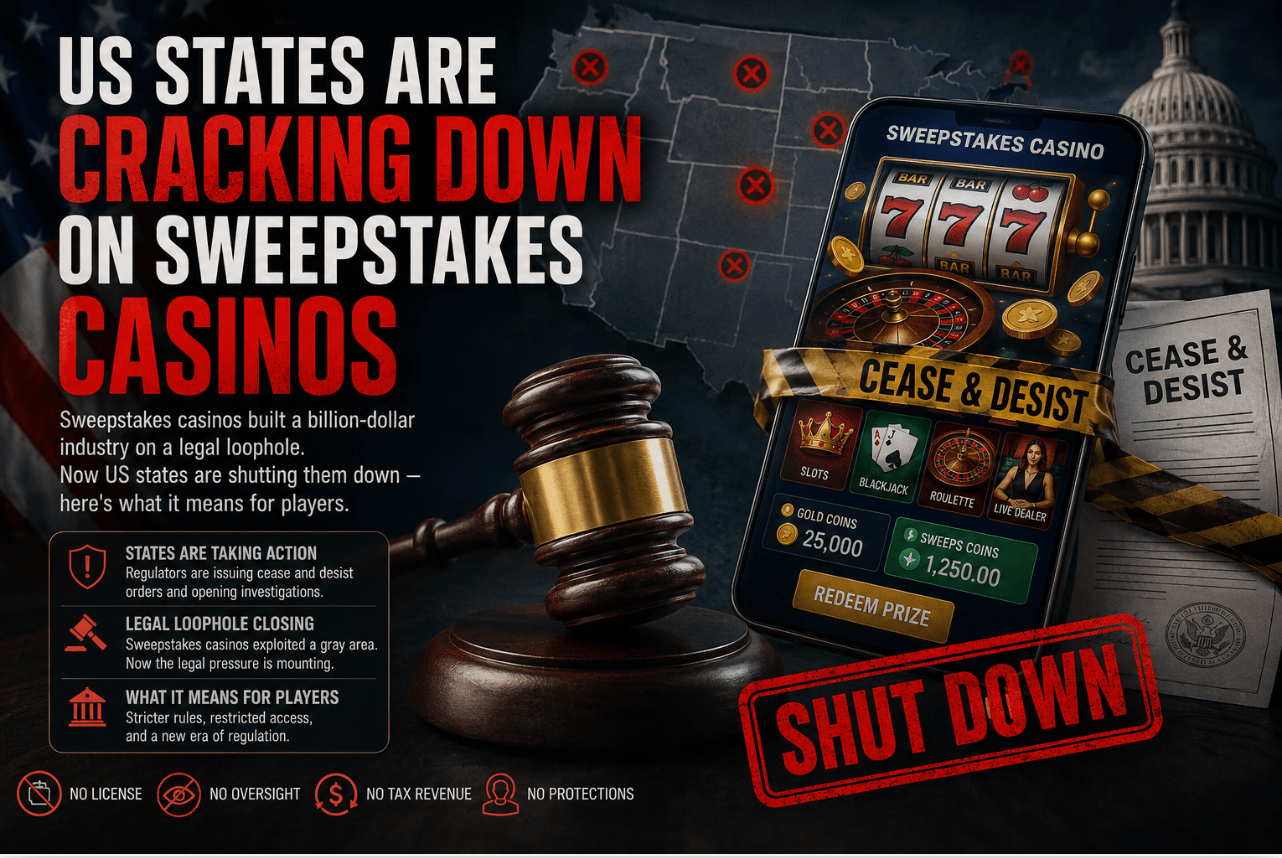
First, let’s take a closer look at how this industry actually works and define what sweepstakes casinos are. Sweepstakes casinos use what’s called a dual-currency system. When you sign up, you get two types of virtual currency:
- Gold Coins are a fun, free-to-use currency. Of course, gamblers can buy more, but they are used just for entertainment and have no value.
- Sweeps Coins are the real action. The thing is that they can be redeemed for cash prizes. However, gamblers receive them for free through mail-in requests or login bonuses; this is the legal mechanism that actually allows this industry to operate.
The main argument was that these are sweepstakes promotions, not gambling, so there’s no addiction and no rules. This entertainment can be treated as a McDonald’s Monopoly game or any other promo from your favorite shop or cafe. You’re just playing a promotional contest, and technically, you can participate for free. That was the legal way to work.
Brands like Chumba Casino and Stake.us built enormous user bases on this model. VGW (the parent company behind Chumba) reportedly generated over $600 million in annual revenue at its peak. They look and feel exactly like real online casinos. Once you open the site, you will see full lobbies of online slots, live dealer baccarat, poker, blackjack, roulette, and online promotions. However, there’s no regulatory overhead.
Why Players Loved Them
Here are the main reasons why these casinos became so popular among gamblers from all over the world:
- Accessibility. They are available in most US states where real-money iGaming is still illegal. Therefore, those who can’t imagine their lives without online casino games can play legally.
- Low barrier to entry. When you sign up, you don’t need to deposit money. You get free coins and can start playing immediately.
- Real prize potential. When you choose pure social casinos, you play for nothing, just for entertainment. Sweeps Coins could be cashed out for real money.
- Familiar gameplay. They offer the same online slots, table games, instant games, etc. If you love, for example, the Sweet Bonanza or Gates of Olympus slot, you can find them here as well.
See the table below comparing both options.
| Feature | Licensed Online Casinos | Sweepstakes Casinos |
| Legal Status | Fully regulated, state-licensed | Operate under sweepstakes/promotional law |
| Currency Used | Real money (USD, CAD, etc.) | Dual: Gold Coins + Sweeps Coins |
| Accessibility | Only in states/provinces with legal iGaming | Available in most US states |
| Regulatory Oversight | State gaming commission, regular audits | Minimal – self-regulated |
| Player Protections | Mandatory – responsible gambling tools, limits | Voluntary, inconsistent |
| Tax Revenue Generated | Yes – significant state tax income | No |
That last row is a big part of why licensed operators and state governments are now pushing back so hard.
The Sweepstakes Squeeze: US States Striking Back

The crackdown has been building for years, but 2024 and 2025 marked the turning point.
Michigan fired one of the first major warning shots, with regulators determining that sweepstakes platforms offering casino-style games, particularly online slots, were operating as illegal gambling. Ohio followed with similar scrutiny. Several other states began issuing guidance that essentially told sweepstakes operators: stop taking players from our jurisdiction, or face legal action.
The American Gaming Association (AGA) has been a consistent force pushing for this crackdown. Their argument is straightforward: if it looks like gambling, plays like gambling, and players can win real money, it’s gambling. Calling it a “promotional sweepstakes” doesn’t change what’s happening on the screen.
The legal pressure also comes from an unexpected angle: consumer protection law. State attorneys general have started framing these platforms as deceptive practices. The free-entry option technically exists, but it’s deliberately buried. Most players engage by purchasing Gold Coins, and the Sweeps Coins attached to those purchases are the real draw.
The Leading Legal Arguments Against Sweepstakes Operators
Regulators and prosecutors have been relying on a few key arguments:
- The “consideration problem”. The classic law of sweepstakes did not require a purchase. But critics say the free mail-in entry is so inconvenient that it’s not a real alternative to buying coins.
- Prize redemption = gambling. Regulators say that when virtual currency can be exchanged for cash prizes, it crosses the line into real-money wagering, regardless of what you call the currency.
- Operation without a license. Running what is essentially an online casino without a gaming license is illegal under state gambling statutes in most jurisdictions.
- Damage to consumers and vulnerable groups. Unfortunately, sweepstakes platforms create real harm to users. They don’t have mandatory responsible gambling tools, spending limits, or age verification standards. Licensed online casinos have this all.
US Regulation vs. Online Casinos in Canada

Pull back and look at the map, and one thing becomes obvious. South of the border: a chaotic, state-by-state patchwork of bans, gray areas, crackdowns, and limited legal markets. North of the border: a more orderly picture is emerging.
Online casinos in Canada operate under a different regulatory philosophy. Canada’s gambling framework is provincial, and Ontario has emerged as the gold standard for regulated iGaming in North America. When iGaming Ontario launched its regulated market in April 2022, it created a legal framework that licensed real-money online casino games, including online slots, from major operators, with strict standards for fairness, player protection, and responsible gambling.
So, what is the key difference? Ontario didn’t try to ban its way to safety and built a legal market that made regulated play attractive. Licensed operators pay taxes, submit to audits, follow responsible gambling rules, and compete openly. Players get the protections, and the province gets the revenue.
Sweepstakes casinos also exist in Canada, but the regulatory clarity around licensed real-money online gambling reduces the motivation to seek gray-market alternatives. When legal options are good, players use them.
Look at the table below to compare these casinos in the US and Canada.
| Aspect | United States | Canada (Ontario Model) |
| Regulatory Structure | State-by-state – fragmented, inconsistent | Provincial – clear jurisdiction, unified rules |
| Legal Real-Money iGaming States/Provinces | 7 states (NJ, PA, MI, CT, DE, WV, RI) | Ontario fully regulated; other provinces vary |
| Sweepstakes Status | Under active legal challenge in many states | Lower regulatory pressure due to available legal market |
| Tax Revenue Model | Only from licensed states | Ontario operators taxed directly |
| Player Protections | Strong in licensed states; absent in gray markets | Mandatory across all licensed operators |
| Market Maturity | Mixed – some states thriving, most without legal options | Growing rapidly – $2B+ annual handle in Ontario |
The US fragmentation is the root of the sweepstakes problem. Players in Texas, Florida, or Georgia have almost no legal options for real-money online casino games. Sweepstakes casinos filled that void. Close them without providing a legal alternative and those players find offshore sites with zero consumer protections.
What Lies Ahead for Alternative iGaming
Nobody in the industry believes sweepstakes casinos simply vanish. The question is what shape they take next.
Here are possible scenarios for 2026:
- Adaptation and licensing. Larger operators like VGW pivot to acquire proper gaming licenses in states where iGaming is legal, abandoning the sweepstakes model in favor of legitimate operation. Licensed operators already offer everything from online slots to modern roulette types and give regulators little reason to tolerate unlicensed alternatives.
- Legal consolidation. The sweepstakes model survives in a stripped-down form, limited to states where it clearly complies with local law, with tighter free-entry standards.
- Legislative expansion. More US states legalize real-money iGaming, removing the market vacuum that made sweepstakes casinos necessary in the first place.
- Offshore migration. Operators unable or unwilling to comply simply move offshore and continue targeting US players, creating an enforcement nightmare similar to the pre-UIGEA era.
- Class action fallout. Player lawsuits over unfair practices accelerate regulatory action and push smaller operators out entirely.
The most likely outcome is a mix of all five. Big players adapt. Smaller ones disappear or go offshore. And the regulated market slowly expands to fill the gap.
What Are Our Predictions?
The sweepstakes squeeze is real, and it’s not slowing down. Players who built their online gaming habits around platforms like Chumba Casino or Stake.us are already feeling the effects: restricted access, changed rules, operators quietly exiting states.
This is the end of the “no rules” era. Whether you’re in the US, still waiting for legal online slots, or already enjoying the licensed market that online casinos in Canada have built in Ontario, one thing is clear: the free-for-all is over. What comes next depends on whether regulators and lawmakers build something better or just leave millions of players with nowhere to go.