The online gambling market revenue reached US$470.09bn in 2024. And in 2026, the average revenue per user is US$653.31. Online gambling is one of the most demanding markets so far, but the world doesn’t stand still. New trends and technological achievements influence its development greatly, and one of them is AI.
The neon signs still flash, and the virtual slot reels still spin. But if you think the online casino industry in 2026 looks anything like it did five years ago, you haven’t been paying close enough attention.
After the post-COVID hypergrowth era, when every lockdown-bored adult with a Wi-Fi connection seemed to discover online poker, and after the regulatory whiplash of 2024 and 2025, when the market scrambled to impose AML checks, affordability screenings, and advertising caps, something quieter has taken over. Underneath the flashy lobbies and bonus pop-ups, AI has embedded itself so deeply into the architecture of online gambling that separating the two is getting genuinely difficult. So, how can AI influence online casinos? Check out this news to stay in the loop!
Your Casino Knows You Better Than Your Therapist

When you walk into a physical casino, someone’s always watching, usually a pit boss with a practiced eye. When you log into your fav casino online, you feel like you are alone there and no one can control you. However, that is not true. There’s a wall of algorithms, and they’re far more observant than any human could be.
For example, 5-6 years ago, a few users could log into their accounts from different countries and with different tastes, but they saw the same set of slots or table games. Simply put, everyone got the same screen. Today, that old-school game lobby is basically dead, and mainly thanks to AI.
Operators now run what’s essentially a live feedback loop built around your behavior. In other words, AI tracks your online behaviour and suggests games that you will definitely appreciate. For example, if you like playing Starmania slot or Fat Banker, you will see them in your favorites. The algorithm is constantly learning from dozens of small signals: how long you hover, what you skip, when you cash out, how you bet when you’re up versus when you’re chasing losses. Game pacing, risk profiles, bonus timing, all of it gets shaped around what the platform has figured out about you.
Let’s see how it looks in practice and analyze three signs that AI is monitoring your playstyle:
- Volatility matching in real-time. Instead of fixed “low/medium/high” slots, AI now dynamically serves game variants or adjusts session pacing recommendations based on your historical risk tolerance. Lose three in a row, and the system might surface steadier, higher-RTP titles, not because it cares about your bankroll, but because players who get nudged stay longer.
- Hyper-targeted promotions. A few years ago, only a standard pack of bonuses was available to all users. However, AI changed this approach. Now, online casino operators know everything about you and prepare customized promotions. They know if you respond better to cashback incentives, free bet credits, or tournament access. That’s why gamblers in 2026 quite often get personalized promos, cashback, free spins, or reloads.
- Session-pace calibration. Some platforms now use AI to slightly slow down autoplay or slip in a brief pause screen when you’re on a hot streak. The main goal of this feature is to keep you playing longer without burning out.
All in all, online casinos that implemented full-stack AI personalization reported year-on-year increases in player engagement of over 30%.
AI Is Winning the Fraud War
For years, online casinos were losing serious money to bonus abusers, fake account networks, and coordinated betting scams. The old systems ran on simple rules like “flag anyone who withdraws more than X times in Y days.” Fraudsters figured those out fast. Some were bypassing them within weeks of a new system going live.
2025 was a turning point. The platforms that invested in machine learning finally had something that could actually keep up, and not because it was faster at applying the same old rules, but because it stopped relying on rules altogether. Instead, it learned to spot patterns. The kind that no compliance team, no matter how experienced, could catch consistently across millions of sessions a day.
See the table below comparing what it was two years ago and what it is today.
| Detection Method | Traditional (Pre-2024) | AI-Driven (2026) |
| Bonus abuse detection | Rule-based thresholds; 60–70% accuracy | Behavioral graph analysis; 98.5%+ accuracy |
| Multi-account identification | Manual IP/device checks | Device fingerprinting + behavioral biometrics |
| Response time | Hours to days (human review) | Real-time, sub-second flagging |
| False positive rate | High (15–20%), frequent false bans | Low (under 3%), with confidence scoring |
| Wash trading detection | Minimal; mostly post-hoc | Live pattern clustering across session graphs |
The problem was never easy. Anybody can see the guy making a hundred withdrawals in one day. What’s impressive now is what these systems are picking up beneath the surface.
Organized groups flagged through something called behavioral clustering; players working together to bleed promotions dry across dozens of verified accounts, hiding behind VPNs and spoofed devices. AI observes your gameplay, sees how fast you tap, and analyzes your betting rhythm. It can notice if your session is just a little too similar to fifty other accounts flagged last month.
It is okay to have one person gaming the system. But it was almost impossible to catch a coordinated network doing it on multiple platforms at the same time.
The Digital Welfare Check Nobody Asked For
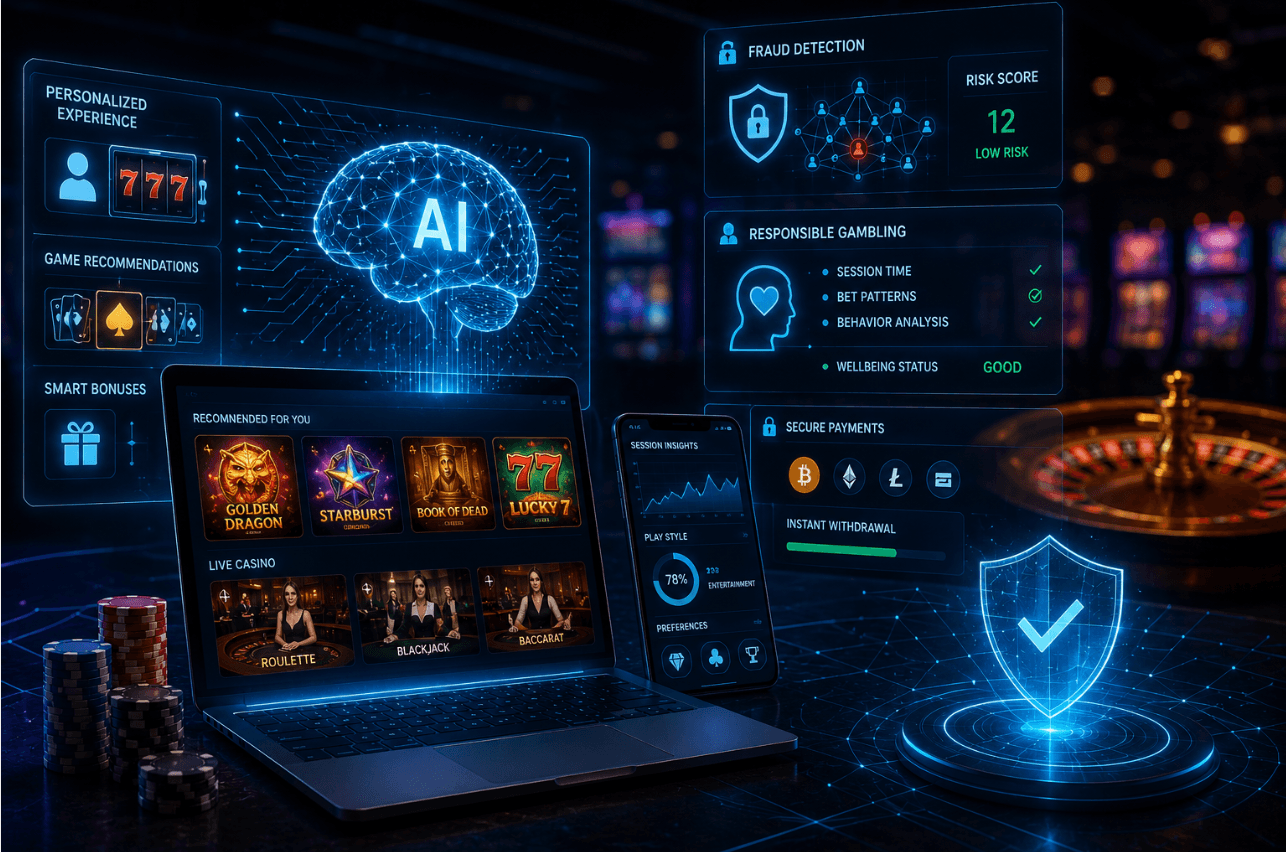
Responsible gambling has been the industry’s most uncomfortable conversation for years. Voluntary self-exclusion tools existed, sure, but the dirty secret was always that the people who needed them most were least likely to use them. By the time someone thought to click “exclude me,” the problem was usually already serious.
AI changed the timing of that intervention. Modern systems now track what the industry has started calling distress signals. They control behavioral markers that correlate with problematic play patterns:
- Sudden stake escalation after losses,
- Rapid session restarts,
- Unusual playtime spikes outside a player’s established patterns,
- Erratic bet-sizing that suggests “chasing.”
Probably these signals individually mean nothing, but when they are grouped together in the right sequence, they are very predictable.
The big difference in 2026, though, is that the AI-triggered interventions happen before any human compliance teams even see the flagged account. If a player exhibits early signs of tilt, they might be presented with an in-session wellness prompt, a limit suggestion, or a brief interstitial break screen. All this can be automatically generated and delivered, in the moment, when it could actually make a difference. Operators say proactive AI interventions have reduced the need for downstream voluntary self-exclusions on sites where they have been fully implemented. The model detects the problem earlier, when responses of lower friction work.
Of course, it is not perfect yet, but it can help identify at-risk players in advance.
The Mobile-First Reality
The infrastructure conversation doesn’t get as much coverage as the AI personalization stories, but it’s just as consequential. None of this works at scale without the plumbing behind it.
5G rollout has finally reached the kind of penetration, especially across European and Asian markets, that makes genuinely low-latency, live-dealer experiences viable on mobile without the janky buffering that plagued 4G-era streams. AI is in the middle of this as an optimization layer; it dynamically adjusts stream quality, UI rendering, and game-state sync based on real-time network conditions. You just enjoy a much better game quality and don’t notice what is going on behind the scenes.
Then there’s crypto. Blockchain payment rails, once a novelty pitched at tech-forward niche players, are now a core infrastructure choice for a meaningful slice of the market. Instant settlement, reduced chargebacks, and pseudonymous transactions (within compliant KYC frameworks) make crypto withdrawals genuinely competitive with traditional banking in most major markets. AI-powered transaction monitoring keeps this compliant without the friction that killed early crypto payment implementations.
Review the table below comparing the market changes.
| Player Experience Metric | 2022 Benchmark | 2026 AI + 5G + Crypto Era |
| Average withdrawal time | 24–72 hours | Under 10 minutes (crypto), 2–4 hours (fiat) |
| Mobile session drop-off rate | ~35% | ~18% |
| Live dealer stream quality complaints | High frequency | Rare; AI auto-adjusts bitrate |
| Personalized bonus relevance (player-rated) | ~40% “relevant” | ~78% “relevant” |
| Fraud, false positive bans | ~15–20% of flags | Under 3% of flags |
The result is a product that has fewer excuses to abandon, fewer loading screens, fewer “please wait for payment processing” messages, and fewer generic offers that feel like they were written for someone else entirely. The friction that used to push players toward competitor platforms or simply away from mobile entirely has been quietly sanded down, one AI optimization at a time.
So What Does All This Actually Mean?
A lot depends on who you are. If you are a casual player, an AI casino powered by AI in 2026 is a more enjoyable option. The games fit your playing style, casino bonuses make more sense, and the payments work perfectly.
If you are an online casino operator, the ROI case for AI investment definitely makes sense. You will get much better engagement, lower fraud losses, and more effective responsible gambling tools.
However, for regulators, the picture is more complicated. The thing is that the same systems that protect players can be tuned to extract more from them. The behavioral profiling that flags distress can also be the engine that prevents churning. Who watches the watchers is a question that several jurisdictions (the UK Gambling Commission, Malta’s MGA, and Ontario’s iGaming regulatory) are actively wrestling with heading into 2027.
And if you’re just a curious observer watching an old, slightly disreputable industry try to modernize itself from the inside out? 2026 is a fascinating moment to pay attention. The casinos haven’t changed their nature and provide the same services. This is the online space where you can always try your luck, play your favourite slots, or join live dealer tables. But the intelligence running underneath it has changed almost everything else.