In February 2026, SPRIBE dropped a LinkedIn post that became viral, and the industry was still talking about it weeks later. The post was about Aviator, a well-known crash game that processed €160 billion in total wagering volume over the course of 2025. By the way, it is one of the largest single-game betting figures in online casino history. Just think about it, only one game, where a little plane climbs a graph until it doesn’t, and you either cash out in time or lose everything. For context, the combined monthly bet volume across Las Vegas, Macau, and London casinos is roughly half that. So far, the online gambling market offers a decent collection of crash games, and they are becoming more and more popular, mainly due to their simple rules. Right now, crash gaming is rewriting the rules of the entire industry.
How Crash Games Work?
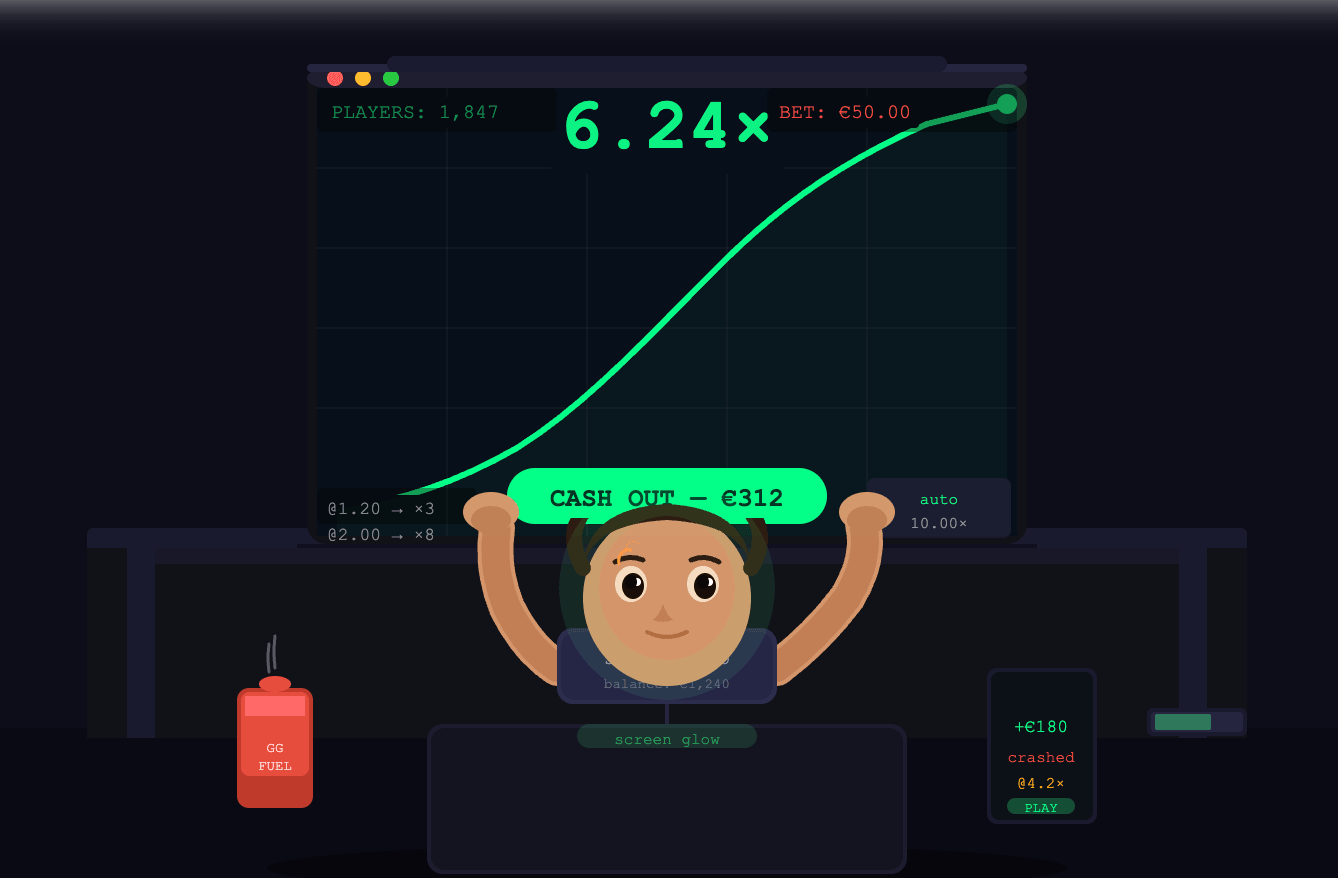
As we have already mentioned, a crash game runs on a single mechanic: a multiplier starts at 1.00x and climbs in real time, players bet before the round begins, and then at some unpredictable moment, the whole thing collapses. Anyone who didn’t cash out loses their stake. These games have no reels, no paylines, no three-minute bonus rounds. On top of that, the game rules are very simple; you don’t need to spend hours learning how to play and what techniques to use to win the game round.
The math is all Provably Fair cryptography, a blockchain system that uses a hash to lock in the crash point before the round begins, which any player can verify afterward. This means that you could audit the outcome yourself. The game gives a level of transparency that traditional slots like Jammin’ Jars or Fat Banker have never offered before. Most serious crash titles have RTPs in the 97% range. This is comfortably above the 94-95% you’ll find on a classic slot. Higher RTP means better payouts.
Here are brief reviews of titles that are extremely popular on the gambling market today:
- Aviator (SPRIBE). This title hit the gambling market in 2019. It is built around a small plane climbing across a graph. Simple interface, massive player base, and the default reference point for the entire genre are the main reasons why gamblers love it so much.
- Spaceman (Pragmatic Play). This game is Pragmatic’s answer to Aviator; it pushed hard through their existing operator network and is now genuinely competing for the top spot in several European markets.
- JetX (SmartSoft Gaming). This one attracts a slightly younger demographic and has carved out strong positions in Latin America and Africa.
All these three titles have the same game rules – a full round resolves in 15 to 45 seconds, compared to a video slot bonus that can drag on for two or three minutes. That speed alone explains a lot about why players find crash games so hard to close.
The Numbers Don’t Lie
Here’s what should be keeping every slot product manager up at night: the crash genre has already grown, and the numbers by mid-2026 are hard to wave away. The format globally pulls over 100 million monthly active users, which puts it in the same ballpark as mid-sized social platforms, and it got there fast enough that the traditional casino industry is still visibly scrambling to catch up.
SPRIBE’s Aviator clocks 77 million monthly active users, and the wagering volume matches: from processing tens of millions in bets a couple of years ago, it has surged past €160 million in monthly wagering value. Review the table below comparing the popularity of these games in different countries.
| Market | Status | Key Driver |
| Brazil | Top-performing title since 2025 regulation | Mobile-first new players, Aviator outperforms Book of Ra |
| Nigeria | Consistent top-3 across major operators | Low data usage, fast rounds suit pay-as-you-go connections |
| Italy | Steady slot share erosion since 2024 | Spaceman and Aviator picked up by major licensed platforms |
| India | Explosive growth via Telegram and crypto operators | Unregulated grey market, massive under-35 demographic |
| UK | Growing but slower — mature regulated market | Streamer-driven acquisition, crypto wallet integration |
Why Your Brain Is Helpless Against It
The psychological design of the format is almost uncomfortably sharp, though no crash game marketing deck will ever say this out loud. The cash-out button creates a totally false sense of control. You think that only you can control the gameplay and decide when to leave and read the curve. However, the crash point was already determined before the round started, so all of the instincts you’re applying are being applied to information that has zero predictive value. And that is what your brain refuses to accept.
The FOMO angle hits differently than in slots. In a slot, outcomes are instant and private; you win or you don’t, and nobody else saw it happen. In a crash game, you watch other players cash out in real time, you see the chat light up when someone exits at 7x, you observe the exact round you chose not to hold through climb past the multiplier you’d have been happy with. The round you missed feels more real than the round you actually played. And this feeling makes you come back to the game again and again.
Here are some other factors that make players come to this format again and again:
- 97% RTP means the house edge is roughly 3%, which is low enough that bankrolls survive long enough to build genuine attachment to the session.
- Multi-volatility controls let players set auto-cashout thresholds, split stakes across two simultaneous bets in the same round, and dial between low-risk 1.3x exits and high-variance attempts at 20x or beyond.
- Round speed means a bad run of five losses takes maybe three minutes, not the twenty-minute death spiral of a cold slot session.
- Public leaderboards and chat create constant social proof that someone, somewhere, is winning and you could be the next winner so quickly, just start playing.
The combination of those four things produces a session dynamic that’s hard to replicate in any other casino format. The game always feels active even when it’s going badly.
Where It Goes From Here
So, what are the main reasons for crash games being popular?
Telegram mini-apps have already become a serious distribution channel in emerging markets, where running a full crash game inside a messaging app with no download and no account verification has pulled in users who’d never navigate a traditional casino lobby. Some operators are reporting Telegram acquisition numbers that their web teams find genuinely uncomfortable.
Crypto integration has gone from selling point to assumption: blockchain settlements fit the pace of a 20-second round in a way three-day bank transfers simply don’t, and stablecoins have become the default currency in markets where conventional banking is unreliable.
The streamer angle is where things get interesting from a pure growth perspective; a climbing multiplier with a crash somewhere ahead is better content than watching a slot auto-spin, there’s visible tension, the chat participates, and there’s a shared moment when it all collapses.
Review the table below comparing what we have now and what will be in the near future.
| Feature | Where It Is Now | Where It’s Heading |
| Telegram integration | Live in 15+ markets via grey operators | Licensed operators are moving in fast as regulation catches up |
| Crypto / stablecoin payments | Standard on crypto casinos, patchy on licensed sites | Becoming a baseline expectation even on regulated platforms |
| Live streamer deals | Organic affiliate relationships, mostly informal | Structured brand partnerships, dedicated crash-game channels |
| Multiplayer tournament modes | Available in JetX and a few Pragmatic titles | Expanding across the genre, linked to shared jackpot pools |
| Social chat overlays | Basic in most titles | Real-time group bets, reaction features, shared cashout celebrations |
The game that looks very easy to play has built one of the stickiest and most scalable products the gambling industry has seen in years. There is no one single strategy that can help you win, no pattern that can be tracked, and no real skill in the cashout decision that can help you trick the system and win. Everything is based on algorithms that were set before, and pure luck. So, cash out when you can.